Sebastian Igelmann, Postdoctoral Researcher
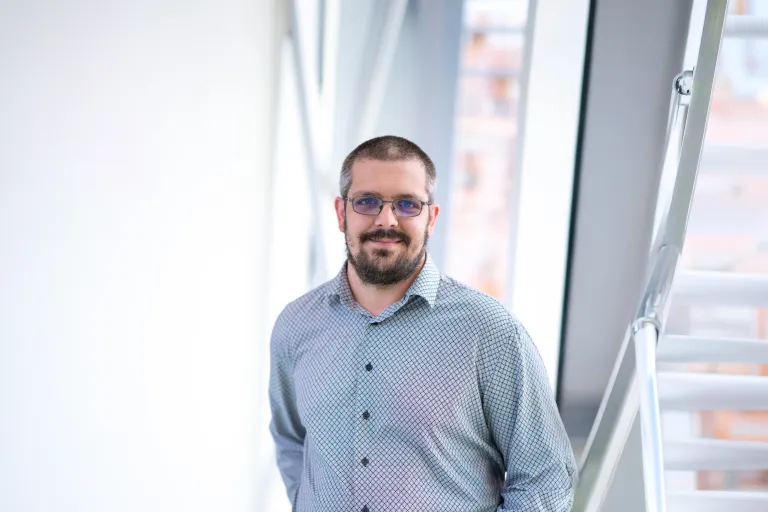
Sebastian Igelmann, Postdoctoral Researcher
Every kid likes a good volcano science experiment, and young Sebastian was no exception. Guided by his high school chemistry teacher, Sebastian spent many free afternoons learning about science through fun chemistry demonstrations. “I still remember some of the silly things we would do, like mix gummy bears into a solution to watch the chemical reaction,” recalls Sebastian. “As a kid, you often do those things just for fun, but they made me really curious about what else was possible to do.”
As a teenager, Sebastian began participating in science fairs with his friends. One project examined how to improve house insulation by developing a polymer composite that absorbed and released heat. “That was a lot of fun,” Sebastian remembers. “We also once worked on a homemade ultrasound-based surface scanner made out of Lego. At the time, it wasn’t about a practical application; it was more about the fun of building and creating these things ourselves.”
Although Sebastian’s high school science projects gravitated towards physics and chemistry, it was biology that eventually won his heart. “During our final years at school, we had a biochemistry module that I absolutely loved, and it made me want to shift in that direction.” For his undergraduate studies, Sebastian went on to pursue a Molecular Medicine Bachelor at the University of Goettingen. “During my bachelor’s, I was introduced to cancer biology for the first time, and I really loved it. After that, I knew I wanted to pursue a PhD in the field, and that I wanted to move abroad to do it. I eventually found a good graduate position at the University of Montreal.”
For his doctoral research, Sebastian investigated how normal cells respond to cellular stress and how different cell stresses can limit or promote cancer initiation. “I was interested in learning about what happened to the cells that didn't become cancerous and how these cells stay in the body, and potentially contribute to aging.” Upon completing his PhD, Sebastian wanted to move back to Europe to continue his research. With his eye on Belgium, Sebastian found the Laboratory for Tumor Evolution and Metastasis led by Sarah-Maria Fendt at CCB, which he joined in 2022.
For the past four years, Sebastian has been investigating how biological changes in aging tissues create a favorable environment for cancer development. “With age, some cancers become more aggressive, and more likely to metastasize,” explains Sebastian. “We have seen that melanoma cells that metastasize to the liver can evade immune detection more easily if the liver has aged. Endothelial cells and other cell types secrete factors that dampen the body’s immune response, and we think this might be one of the reasons cancer cells can survive and grow more effectively.”
Next year, Sebastian will move to Montreal once more – this time to start his own research group at the Institute for Research in Immunology and Cancer (IRIC), where he will continue his research on the interactions between cancer and aging. As he talks about his research, a smile overtakes his expression and you quickly realize how much he enjoys his work. “One of the most rewarding parts is seeing the results come together and realizing your initial idea wasn’t as silly as you might have thought. Sometimes things work out as expected, and sometimes things turn out to be more of a surprise. But in the moments when you are analyzing your data and the pieces start coming together… there’s a great and very fulfilling feeling in that.”
Sebastian, it’s been great having you at CCB, and we wish you all the best in your next chapter! Thank you for all your hard work and dedication to cancer research ✨